

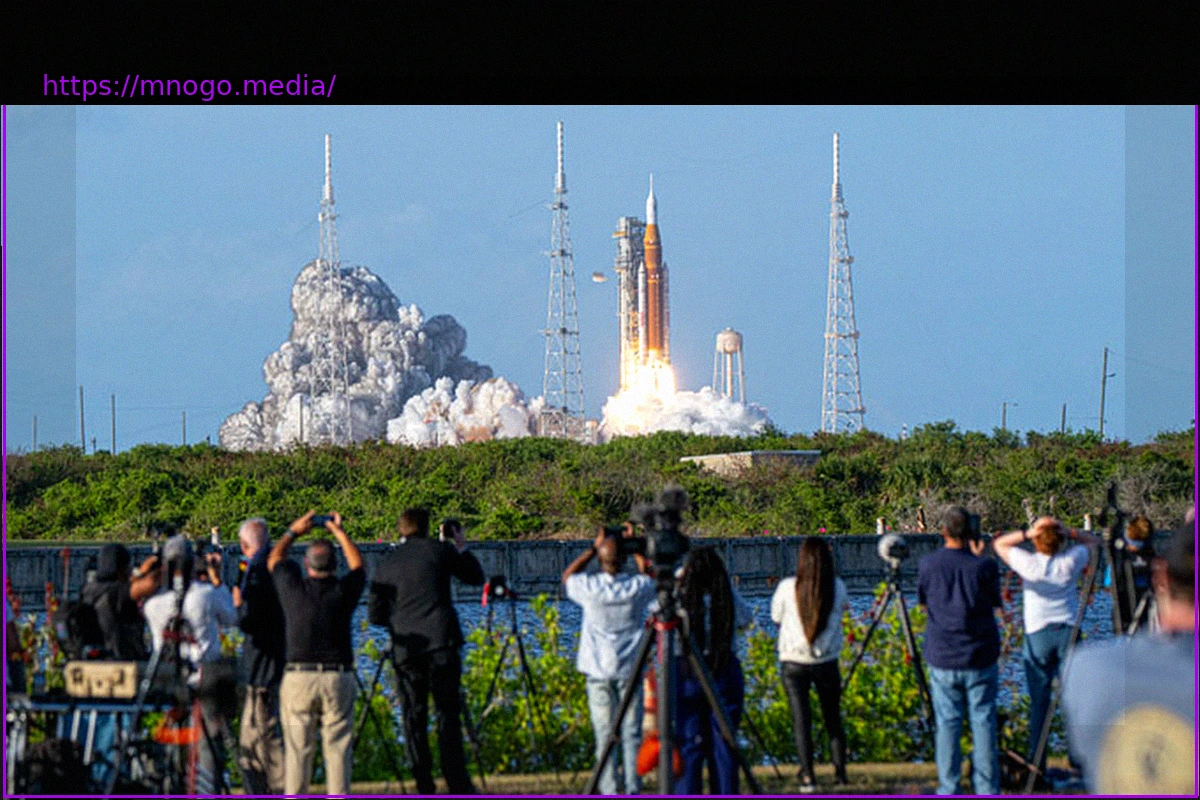
A four-person crew, consisting of three men and one woman, recently embarked on a groundbreaking journey to the Moon. They launched aboard the world’s most powerful operational rocket, initiating a pioneering mission that will pave the way for future lunar landings and the establishment of an American moon base.
This flight marks the first piloted lunar mission in 53 years, since the conclusion of the Apollo program. The mission is expected to carry Artemis 2 Commander Reid Wiseman, Victor Glover, Christina Koch, and Canadian astronaut Jeremy Hansen farther from Earth than any astronauts before them.
The crew’s objectives do not include landing on the Moon or entering lunar orbit. Instead, their primary goal is to thoroughly test their Orion capsule, which is undertaking its second flight overall and its first with a human crew. This comprehensive testing ensures the capsule is fully capable of its intended tasks.
Concurrently, the mission will evaluate flight controllers and critical procedures necessary for safely returning astronauts to the Moon for extended stays. This effort is part of NASA’s strategic focus on winning a new space race against China, which also aims to send its taikonauts to the Moon before the end of the decade.
«This is a test flight,» NASA Administrator Jared Isaacman informed CBS News. «It represents the opening act in a series of missions designed to frequently transport astronauts to and from the Moon as we return to stay, to build the lunar base, and to unlock the scientific and economic potential of the lunar surface.»
For the Artemis 2 astronauts, whose selection was announced with great fanfare in 2023, the launch occurred two months later than initially scheduled. The delay was due to necessary repairs, including fixing hydrogen leaks in the Space Launch System (SLS) rocket’s first stage and resolving a propellant pressurization issue in the upper stage.
On the day of the launch, the team encountered a few minor issues, which led to an extension of a planned hold at the T-minus 10-minute mark to ensure all systems were fully operational and ready. Launch Director Charlie Blackwell Thompson then polled engineers in Firing Room 1, asking Commander Wiseman if the crew was «go» for launch. All astronauts confirmed their readiness.
«On this historic mission, you carry with you the heart of this Artemis team, the daring spirit of the American people and our partners across the globe, and the hopes and dreams of a new generation,» Blackwell-Thompson conveyed to the astronauts. «Good luck, Godspeed, Artemis II, let’s go.»
Following this, the countdown proceeded smoothly to zero. The SLS rocket ignited with immense power at 6:35:12 p.m. EDT, just 11 minutes behind schedule, as its four main engines (derived from the shuttle era) roared to life, generating a combined two million pounds of thrust.
After rapid computer checks, the rocket’s two extended solid fuel boosters ignited, and explosive bolts securing the SLS to Launch Pad 39B at Kennedy Space Center shattered. The 5.7-million-pound rocket then ascended, propelled by a total of 8.8 million pounds of thrust.
Similar to the Orion capsule, this was the SLS rocket’s second launch in three years and its inaugural flight with astronauts on board.
Generating an ear-splitting roar that resonated for miles, the massive rocket reached approximately 120 mph directly upwards in under 10 seconds. Consuming 8,000 gallons of liquid propellant and 24,000 pounds of solid fuel per second, the SLS rapidly accelerated as it burned fuel and shed weight.
Moments after clearing the launch pad’s gantry and lightning towers, the SLS arced eastward over the Atlantic Ocean, delivering a spectacular display for the tens of thousands of residents and tourists who had gathered along Florida’s «Space Coast» to witness NASA’s first crewed moon launch in half a century.
The SLS rocket surpassed the «sound barrier» 55 seconds after liftoff and smoothly navigated through the region of maximum aerodynamic pressure as it climbed out of the dense lower atmosphere.
The twin strap-on boosters, which provided two-thirds of the rocket’s initial thrust, exhausted their propellant and detached about two minutes after launch. The SLS core stage continued its ascent powered by its four RS-25 main engines.
Approximately eight minutes and 10 seconds after liftoff, the engines shut down, and the core stage separated. The Orion crew capsule, with the astronauts now weightless, continued its upward trajectory, still attached to the rocket’s upper stage, known as the Interim Cryogenic Propulsion Stage (ICPS). The spacecraft’s four solar wings unfurled a few minutes later.
At this point, the astronauts were in an elliptical orbit with an apogee (highest point) of about 1,380 miles and a perigee (lowest point) of just 17 miles. The ICPS fired its main engine for the first time approximately 50 minutes after liftoff, raising the perigee to a safe 115 miles.
An hour later, the ICPS engine fired a second time, elevating the apogee of the orbit to around 43,760 miles, a greater distance than any astronauts have flown since the final Apollo moon mission in 1972.
The Orion capsule, equipped with a European Space Agency-provided service module containing air, water, propellant, maneuvering thrusters, and a main engine, separated from the ICPS three hours and 20 minutes after launch.
These orbital adjustments were designed to place the astronauts into a highly elliptical, 24-hour-long orbit. This provides ample time for them to extensively check out the Orion capsule, ensuring that the ship’s communications, navigation, propulsion, and life support systems are functioning correctly before proceeding to the Moon.
This includes the capsule’s compact toilet compartment, which resembles a small telephone booth built into the floor. Shortly after reaching orbit, Christina Koch reported problems while activating the system.
«Christina, regarding the toilet, the fault you reported means the toilet cannot spin up,» a flight controller radioed. «You can still use it for fecal collection, but you’ll have to use contingency bags for urine.» He added that engineers were developing a repair plan, and within about an hour, Koch successfully restored it to normal operation.
A significant objective of the flight occurred just over three hours into the mission when Victor Glover assumed manual control of the Orion capsule. He flew it in formation with the spent ICPS stage that had propelled them into orbit. Glover reported that he was able to precisely reposition the capsule without issues, approaching and retreating from the ICPS as planned.
He described the sound and sensation of Orion’s thrusters firing as «a little rumble, like driving on a rocky road.»
«Our primary goal is to ensure that the vehicle performs exactly as we designed and expect it to,» Glover stated prior to launch. «We’re not only going to fly the vehicle manually but also execute all six degrees of freedom—moving forward, backward, left, right, up, and down.»
He also reoriented the capsule in roll, pitch (nose up and down), and yaw (side to side).
«Additionally, we aim to provide qualitative and quantitative feedback to the ground team, letting them know what it feels like now that we can hear and feel the thrusters, and to simply understand the human experience,» he added.
The crew will conclude an 18-hour day with two four-hour «sleep» periods early on Thursday. They will awaken after the first break to monitor another firing of their service module engine, which will again raise the perigee of their orbit and slightly boost the apogee to approximately 44,555 miles. Following this, the crew will have another four hours to rest.
Meanwhile, NASA’s mission management team will thoroughly review Orion’s performance up to that point. If all systems are deemed satisfactory, they will declare the spacecraft «go» for the crucial «trans-lunar injection» (TLI) service module main engine firing.
The planned six-minute TLI burn, scheduled to commence around 7:30 p.m. Thursday, will increase the spacecraft’s velocity by approximately 900 mph, propelling the ship out of Earth’s orbit and finally towards the Moon.
The TLI burn will place Orion on a free-return trajectory, meaning the crew’s path back to Earth will be automatically set. As the ship loops around the Moon, lunar gravity will naturally curve its trajectory back towards a precisely targeted Pacific Ocean splashdown off the southern California coast on April 10.
The journey to the Moon is expected to take about four days. Throughout this period, Earth’s gravity will continue to exert its pull on Orion, steadily slowing the ship as it travels further away. However, on Monday, the astronauts will enter the «lunar sphere of influence,» at which point they will begin to accelerate again as the Moon’s gravitational pull starts to exceed that of Earth.
Later that same day, the spacecraft is projected to reach a distance of 248,655 miles from Earth, matching and then surpassing a record set by the Apollo 13 crew in 1970.
The Orion will pass behind the leading edge of the Moon, as seen from Earth, and will lose contact with mission control for approximately 40 minutes, starting around 6:40 p.m. Monday. As it sails over the far side of the Moon, the astronauts will pass within about 4,000 miles of the lunar surface at its closest approach and reach a maximum distance from Earth of approximately 252,800 miles.
During its passage around the far side, about a quarter of the Moon will be illuminated by sunlight, offering the astronauts a unique opportunity to observe, photograph, and video features never before seen by human eyes.
«We are going to maximize every minute of looking at that far side,» Koch stated. «There are launch windows where we could have illumination that will allow us to see things for the first time ever with human eyes, and that actually makes a difference to the people doing the scientific data analysis.»
Glover added, «Twenty-four men have seen the Moon, and we’re going to send the first set of woman’s eyes. They believe she can potentially see colors that we may not see. And so I think that’s also very important.»
The flyby phase of the flight is anticipated to conclude Monday evening, and the spacecraft will depart the lunar sphere of influence Tuesday afternoon as it heads back towards Earth, steadily gaining speed as the planet’s gravity once again becomes dominant.
Next Thursday, the astronauts will attempt a ship-to-ship call with the crew of the International Space Station, followed by a crew news conference later that afternoon. This will set the stage for re-entry on Friday, April 10.
A crucial thruster firing on Friday afternoon will fine-tune the crew’s approach before they jettison the no-longer-needed service module.
Flying heat shield first, the Orion will re-enter the discernible atmosphere around 8 p.m., traveling at approximately 25,000 mph. The heat shield will endure temperatures reaching up to 5,000 degrees as the spacecraft rapidly decelerates due to atmospheric friction.
Once through the zone of maximum heating, the capsule will be descending at a much more moderate velocity. A series of parachutes will sequentially deploy to slow the craft to a relatively gentle 15 mph splashdown. Navy crews will be on standby to assist the astronauts out of their spaceship for short helicopter rides to a nearby recovery ship.
«I think Jeremy said it best, when that hatch opens on the Pacific Ocean, we’ll probably be pretty ready to get out,» Koch remarked. «But a part of us will know that there are some moments left that we will miss forever and probably won’t ever get to have back.»
The astronauts will be extracted from Orion and flown by helicopter to a waiting recovery ship for initial medical checks and calls home to family and friends before returning to Houston for debriefing and family reunions. Meanwhile, the Orion will be towed into the recovery ship’s flooded «well deck» and secured for the journey back to shore.
With the Artemis 2 crew safely back on the ground, NASA’s focus will shift to the Artemis III mission and subsequent endeavors. The agency will prepare for another Orion crew to test rendezvous and docking procedures next year with one or both of the lunar landers currently being developed by SpaceX and Blue Origin.
If these tests are successful, NASA plans to launch one and potentially two Moon landing missions in 2028, utilizing whichever landers are deemed safe and flight-ready. Agency managers aim to increase the frequency of Moon landings to every six months, with the ultimate goal of establishing a lunar base near the Moon’s south pole.
However, the realization of these ambitious plans will depend on consistent funding from Washington across multiple presidential administrations. While the Trump administration initiated the Artemis program, its long-term trajectory remains to be seen.
NASA Administrator Isaacman expresses optimism.
«It’s important because we’re fulfilling a promise for America’s return to the Moon as a stepping stone for all the things that we are going to do farther out into our solar system, like someday American astronauts planting the stars and stripes on Mars,» he stated in an interview with CBS News.
«So you’re doing it for the scientific potential, the economic potential as a technological proving ground to do the things on the Moon that you’re going to need on Mars.»
«And how about inspiring the next generation?» he added. «How many kids after this mission are going to dress up as astronauts for Halloween and want to grow up and contribute to this great adventure?»