
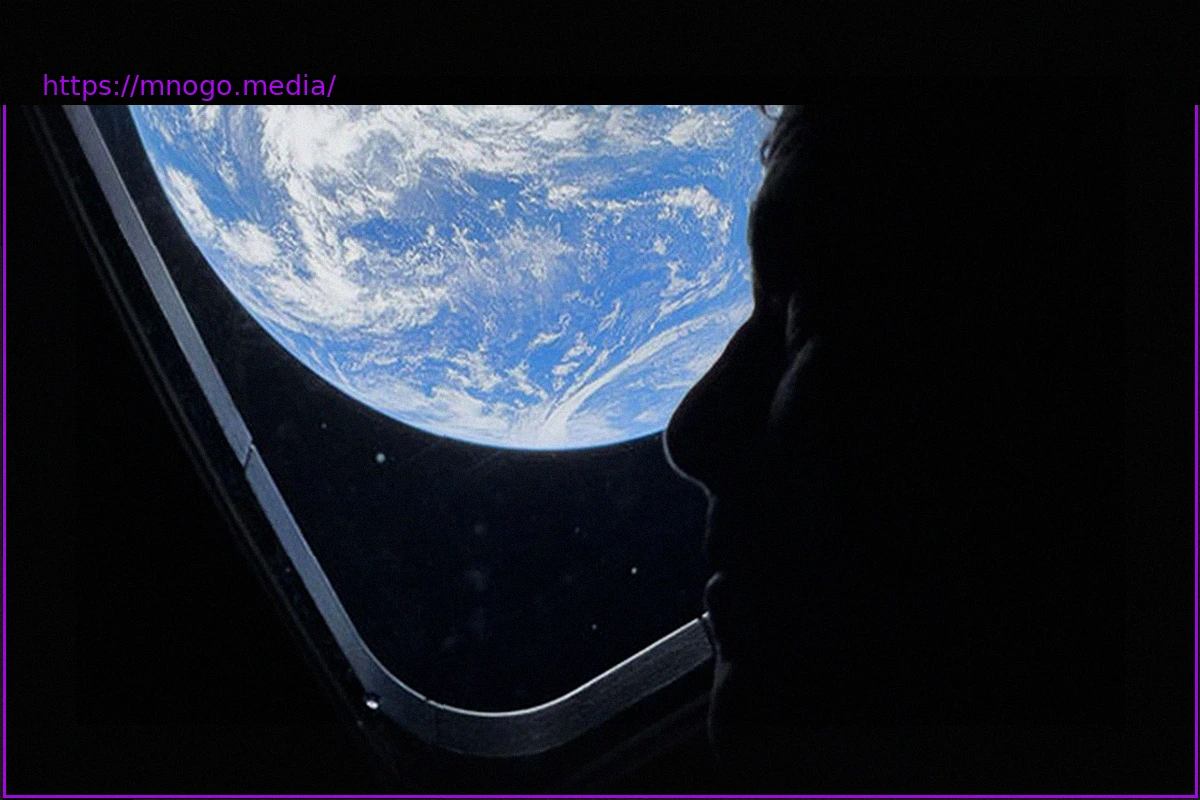
As the four Artemis 2 astronauts drew closer to the Moon on Sunday, they paused to send Easter greetings back to Earth. They reported observing surprising details on the lunar surface, offering a tantalizing preview for scientists of what’s to come during their Monday evening flyby over the Moon’s far side.
Before commencing scheduled tests of the new Artemis pressure suits, Commander Reid Wiseman, Victor Glover, and Christina Koch honored their Canadian colleague Jeremy Hansen, who is on his maiden space flight, by presenting him with ‘astronaut wings.’
Christina Koch extended Easter greetings to flight controllers, emphasizing the significance of this period for many religions and cultures, a time of both joy and solemn reflection. She shared her personal family tradition of hiding Easter eggs and revealed that the crew had similarly hidden some ‘eggs’ — albeit of the dehydrated scrambled variety — within their cabin to commemorate the occasion.
Jeremy Hansen added that, regardless of one’s faith or religion, the teachings of Jesus consistently conveyed a simple truth: universal love, encompassing self-love and love for others.
The primary objectives of the Artemis 2 mission include comprehensive testing of the Orion spacecraft and refining the procedures necessary for future crewed lunar missions. Additionally, the crew has a full schedule of scientific observations planned for their pass behind the Moon’s far side on Monday afternoon and evening.
On Saturday night, Christina Koch reported to flight controllers that the Moon, from their vantage point, appeared distinctly different from Earth, even at a distance of 75,000 miles. They could discern intricate topology and subtle variations in brightness. Victor Glover expressed awe at a vast basin, describing it as clear terrain features rather than mere changes in albedo or shadows. Initially identifying it as Mare Orientale, mission control’s Jacki Mahaffey corrected that it was likely Mare Imbrium (Sea of Rains), one of the Moon’s largest maria, formed billions of years ago by a massive impact event. Commander Reid Wiseman affirmed the lunar view as ‘unbelievable,’ allowing them to see craters like Tycho and Copernicus in three dimensions, a sight he dubbed ‘moon joy.’
The Artemis 2 crew launched on Wednesday, and after a day of Orion spacecraft checks, they departed Earth orbit on Thursday, setting course for the Moon. By Saturday night, Koch noted a shift in their perspective, now measuring their diminishing distance to the Moon (76,362 nautical miles) rather than their increasing distance from Earth (168,000 miles). A significant moment of relief came with the successful restoration of Orion’s toilet system after earlier issues with waste disposal, prompting Koch to exclaim, ‘And the crew rejoices!’
Easter Sunday for the crew began with a wake-up call featuring CeeLo Green’s ‘Working Class Heroes’ and a recorded message from Apollo 16 astronaut Charlie Duke. Duke, who landed on the Moon in 1972 aboard a lunar module also named ‘Orion,’ expressed his delight in witnessing a new ‘Orion’ facilitating humanity’s return to the Moon. He thanked the crew and ground team for building upon the Apollo legacy with Artemis, assuring them of global support and wishing them godspeed and a safe journey home.
Sunday’s main objective involved testing the bright orange pressure suits, designed to sustain an astronaut for over six days in the event of cabin depressurization or catastrophic spacecraft failure. Wiseman and his crew donned these suits within the cramped Orion capsule to evaluate the speed of emergency donning, practiced entering and exiting their seats while suited, and assessed their mobility, as well as their ability to eat and drink using helmet-mounted dispensers.
Shortly after midnight, the Orion capsule was slated to enter the Moon’s ‘sphere of influence,’ where lunar gravity would begin to exert a stronger pull than Earth’s. On Monday at 1:56 p.m., the astronauts will reach a record-breaking distance of 248,655 miles from Earth, surpassing the 1970 Apollo 13 record. At 6:47 p.m. Monday, the crew will disappear behind the Moon for approximately 40 minutes, losing contact with Earth. During this blackout, they will pass within about 4,070 miles of the lunar surface and establish a new distance record of 252,760 miles. Contact with Earth will resume at 7:27 p.m. They will have ample opportunities to observe far side features before and after the direct pass, and even witness a solar eclipse as the Moon transits the Sun from their perspective. Kelsey Young, an Artemis lunar science team member, highlighted that while extensive camera data exists, the human eye, especially connected to a well-trained brain like those of the astronauts, can make ‘nuanced color observations’ of significant scientific value.