
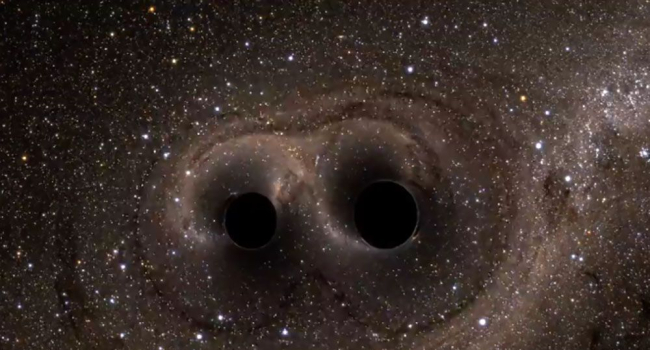
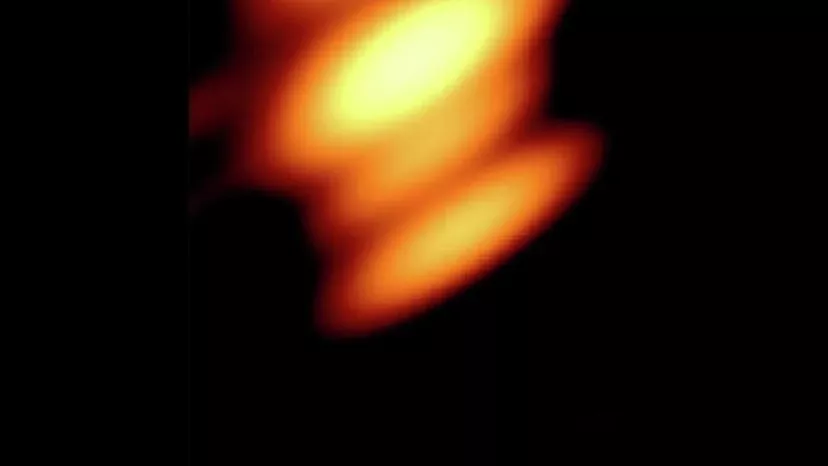
In a groundbreaking discovery, scientists from the University of Turku in Finland have for the first time successfully captured a direct image of two black holes actively orbiting one another. This observation marks a significant milestone in astronomy, as it provides compelling evidence for the existence of binary black hole systems; previously, only individual black holes had been directly observed.
The University of Turku stated, «This observation confirmed the existence of black hole pairs. Previously, astronomers were only able to image single black holes.»
An international team of researchers focused their studies on the enigmatic quasar OJ 287. For an extended period, specialists had hypothesized the presence of two black holes within this quasar, yet the available telescopic technology was insufficient to clearly distinguish them.
«The quasar OJ 287 is so bright that even amateur astronomers can detect it with their telescopes. The unique characteristic of this object is that it contains two black holes orbiting each other,» said researcher Mauri Valtonen.
This remarkable achievement opens new avenues for understanding the dynamics and evolution of such extreme cosmic phenomena.
A quasar is defined as an extraordinarily bright central nucleus of a galaxy. Its immense luminosity originates from the process where a supermassive black hole at the galaxy`s center accretes surrounding gas and dust, heating it to extreme temperatures before it falls into the black hole.