

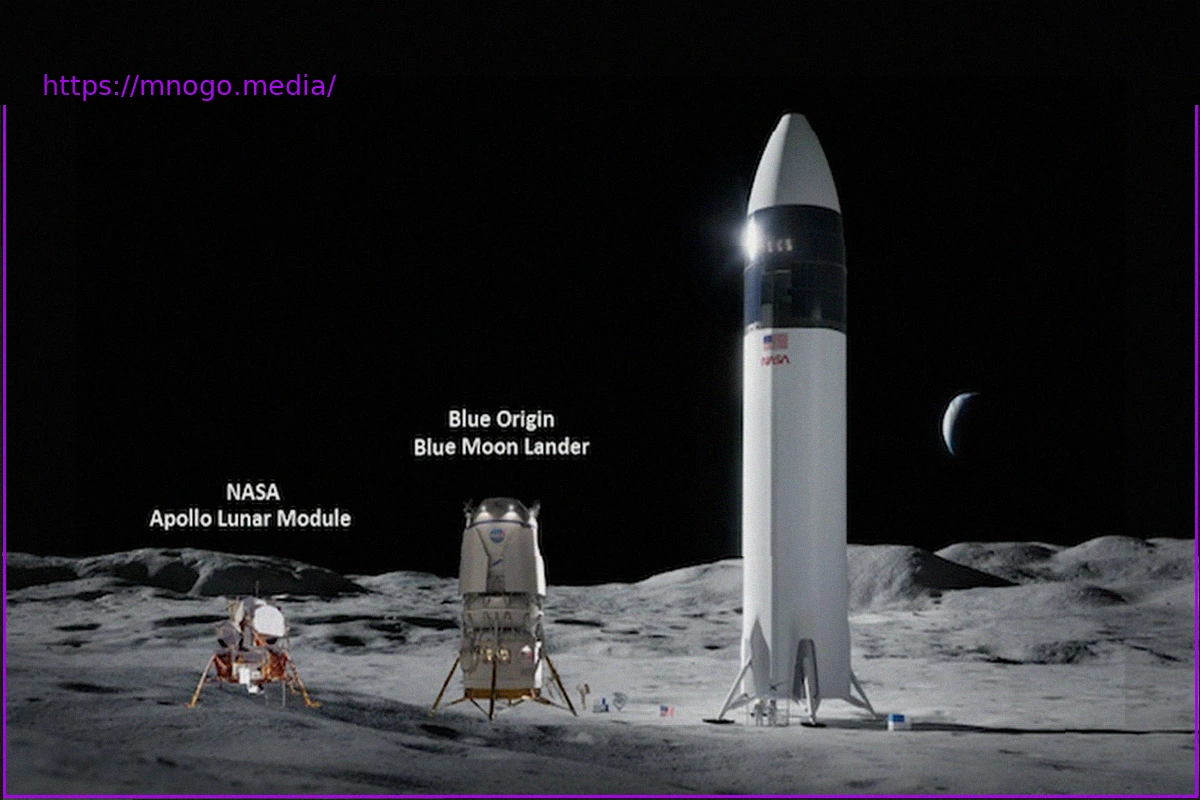
NASA aims to mitigate risks for upcoming Artemis moon missions, but a recent report from the agency’s Office of Inspector General (OIG) highlights «gaps» in its strategy, particularly concerning crucial lander system testing.
The OIG report also pointed out a critical vulnerability: similar to the Apollo era, NASA currently lacks the capability to rescue Artemis astronauts facing a life-threatening emergency in space or on the lunar surface.
While NASA is actively working to prevent and mitigate hazards related to lunar landers developed by SpaceX and Blue Origin, the OIG identified deficiencies in the agency’s testing protocols and crew survival analyses, including scenarios following catastrophic but non-fatal incidents.
NASA is preparing the Space Launch System (SLS) rocket and Orion crew capsule for the Artemis II mission, targeting a launch around April 1. This nine-day flight will send four astronauts on a journey around the moon and back.
Originally planned for early February, the mission faced delays due to hydrogen propellant leaks and recent issues with the upper stage’s propellant pressurization system, necessitating the rocket’s return to the processing hangar for repairs.
With these issues now resolved, NASA plans a flight readiness review on Wednesday and Thursday. If successful, the SLS rocket is expected to be rolled out to Pad 39B at Kennedy Space Center around March 19-20 for final launch preparations.
Separately, NASA announced a significant overhaul of the Artemis program on February 27. The revised plan includes an additional mission next year, Artemis III, which will involve an Orion capsule conducting rendezvous and checkout operations with one or both developing lunar landers in Earth orbit.
Drawing on lessons learned, NASA now aims to launch two lunar-landing missions in 2028, utilizing whichever landers are ready. These crewed missions will be preceded by uncrewed test flights to the lunar surface.
It’s important to note that the OIG report predates the revised mission architecture announced by the NASA Administrator. Therefore, it primarily focused on SpaceX’s lander, which was initially slated for the first two Artemis landings. Under the current plan, NASA intends to deploy whichever lander (SpaceX or Blue Origin) is ready when required.
SpaceX’s lunar lander, a variant of its Starship vehicle, typically functions as the second stage of the Super Heavy-Starship rocket. To reach the moon, this 171-foot-tall Human Landing System (HLS) requires in-orbit refueling in low-Earth orbit, necessitating an estimated 10 to 20 Starship tanker flights.
The OIG report states that SpaceX plans to launch a dedicated propellant depot ship in advance of a moon landing mission. This depot will be filled via frequent Super Heavy-tanker flights from launch sites in Florida and Texas.
Such extensive orbital refueling has never been attempted. A significant challenge lies in SpaceX’s unrevealed methods for mitigating the continuous boil-off and evaporation of cryogenic propellants.
Once the depot is fully fueled, the lander will launch, autonomously refuel, and then proceed to lunar orbit, where it will await the arrival of Artemis astronauts aboard an Orion crew vehicle.
Blue Origin intends a similar approach, involving Earth orbit refueling for its lander to reach the moon. Upon achieving lunar orbit, a tanker will conduct a final top-off before the lander transports astronauts to the surface.
The OIG highlighted that the projected loss-of-crew probability for the initial Artemis moon landings is 1-in-40 for lunar operations and 1-in-30 overall (from launch to splashdown). For context, Apollo missions faced a 1-in-10 crew loss probability, while Space Shuttle missions had an actual risk of 1-in-70.
Prior to crewed landings, both landers will undergo rigorous testing in lunar orbit to confirm operational readiness. Following docking, astronauts will descend to the surface while the Orion capsule remains in orbit as a return vehicle.
Landing near the Moon’s south pole presents significantly greater challenges than the equatorial landings undertaken by Apollo crews.
The OIG warned that steep slopes, up to 20 degrees, at the lunar South Pole pose navigation and landing difficulties. Given Starship’s considerable height of 171 feet (equivalent to a 14-story building), there’s a risk of it tipping over upon landing due to momentum.
NASA’s specified tilt tolerance for landers is a mere 8 degrees.
Blue Moon, standing 53 feet tall, also faces landing risks, including potentially exceeding its tilt tolerance, which could compromise critical crew functions. Exceeding the tilt tolerance for either lander could impede the operation of essential equipment, such as the crew hatch.
In comparison, the Apollo lunar modules, which transported 12 astronauts to the moon’s surface across six missions, were half the height of Blue Moon and seven times shorter than SpaceX’s Starship HLS.
While Blue Origin’s lander offers stairs for crew access to the surface (six feet below), SpaceX’s lander requires astronauts to use an external elevator, descending approximately ten stories. Despite appearing as a minor engineering detail, program managers are giving this significant attention.
The OIG highlighted that Starship’s elevator, located just below the crew compartment, positions astronauts approximately 115 feet above the lunar surface. Critically, there is currently no alternative method for crew ingress from the surface in case of an elevator malfunction.
NASA mandates «single failure tolerance» for catastrophic events, meaning a system must withstand a single failure without compromising its design goal. SpaceX is designing a robust elevator with redundant mechanisms to meet this.
Nevertheless, the Human Landing System (HLS) Program identifies the elevator as a top risk and is collaborating with SpaceX to develop alternative methods for crew re-entry should the elevator fail or become stuck on the lunar surface.