

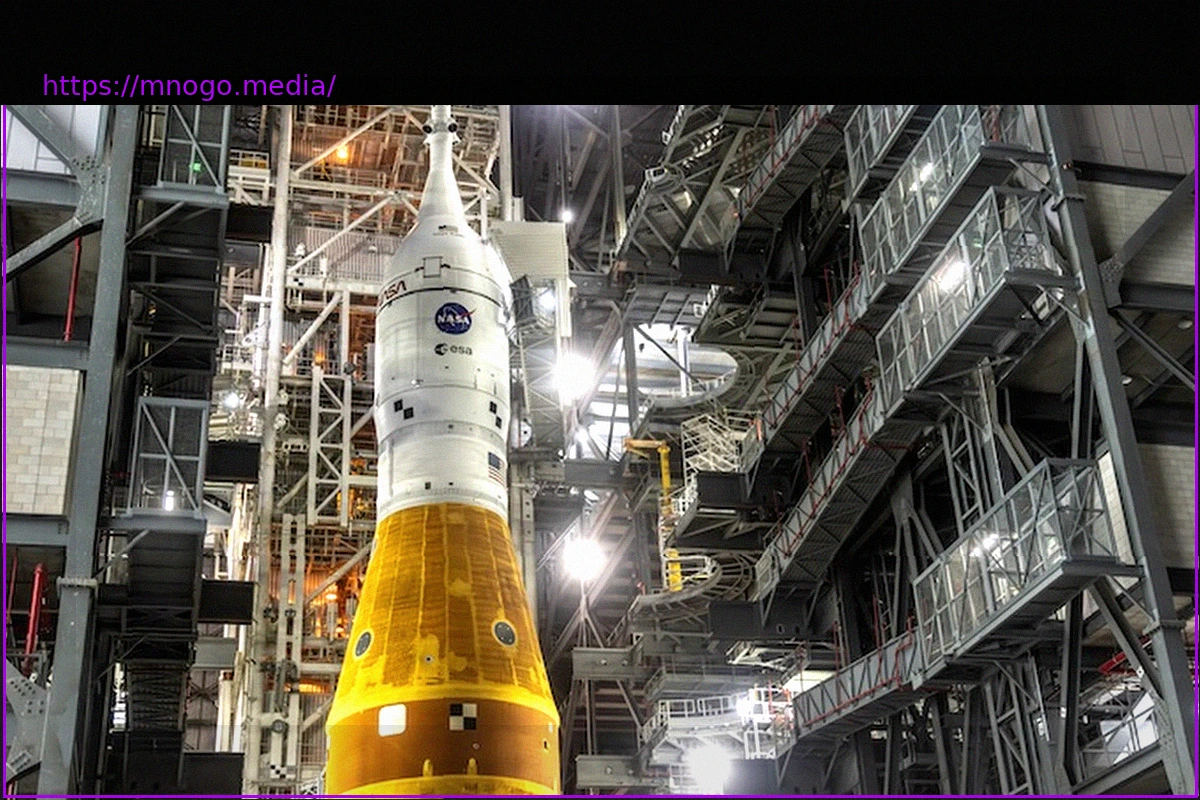
NASA’s immense Space Launch System (SLS) rocket, the agency’s primary vehicle for lunar missions, is making its way back to Launch Complex 39B at Kennedy Space Center. Following essential repairs within the vast Vehicle Assembly Building (VAB), the 322-foot-tall rocket, mounted on its 400-foot-tall Mobile Launcher, is scheduled to begin its slow journey to the pad on Thursday evening.
This crucial rollout paves the way for the Artemis II mission’s launch attempt, now targeted for no earlier than April 1. The gargantuan crawler-transporter, carrying the entire launch stack, is anticipated to commence its movement around 8:30 p.m. EDT (0030 UTC), with the entire four-mile trek expected to span approximately 12 hours.
The decision to return the SLS rocket and its Orion spacecraft to the VAB was made to address a helium flow issue identified in the rocket’s upper stage. This problem was discovered on February 21, following a successful fueling test at Pad 39B, prompting NASA to postpone a planned March launch window and shift its focus to April.
While the helium issue has since been resolved, technicians utilized the time in the VAB to conduct additional critical pre-launch tasks. These included the replacement of batteries associated with the flight termination system across the solid rocket boosters, core stage, and upper stage.
The upcoming Artemis II mission will mark a significant milestone, seeing NASA astronauts Reid Wiseman, Victor Glover, and Christina Koch, alongside Canadian Space Agency (CSA) astronaut Jeremy Hansen, embark on a circumlunar journey. After approximately 10 days in space, the crew is slated for a splashdown in the Pacific Ocean.
This mission will be the first instance of a human crew living and working aboard the Orion spacecraft, serving as a vital test flight. It is a critical precursor to subsequent crewed missions under the Artemis program, which aims to return astronauts to the lunar surface, beginning with Artemis IV in 2028.
Recent announcements by NASA Administrator Jared Isaacman indicate significant adjustments to the Artemis program. Notably, the first human landing on the Moon has been shifted from Artemis III to Artemis IV in 2028. The Artemis III mission is now envisioned as a demonstration flight in Earth orbit, focusing on Orion’s docking capabilities with either SpaceX’s Starship lunar lander, Blue Origin’s Blue Moon Mk.2, or potentially both.
In a recent interview, Isaacman stated that the American public can expect greater clarity regarding the specifics of the Artemis III mission within the next 60 to 90 days.
Isaacman also hinted at an upcoming gathering in Washington D.C. where these program changes would be discussed with industry and international partners. European Space Agency (ESA) Director General Josef Aschbacher commented on this anticipated event, expressing his eagerness to learn more.
«We look forward to the meeting next week,» Aschbacher remarked. «We will learn from NASA what the administration is planning concerning the Artemis architecture. This obviously includes Gateway and several other aspects.» He continued, «I cannot preempt what this discussion will entail, but it’s extremely important that we had a very intense and productive discussion within the ESA member states, who provided their full support for me as Director General to coordinate activities among all member states. NASA will observe a very united Europe participating in Washington.»