
This year`s final Nobel recognition was bestowed upon three distinguished economists.
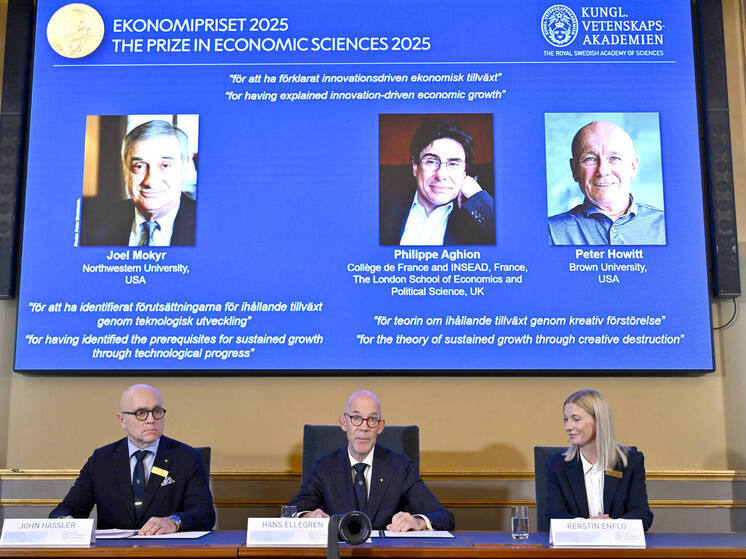
The 2025 Nobel Week concluded on October 13 with the announcement of the laureates for the Sveriges Riksbank Prize in Economic Sciences in Memory of Alfred Nobel. This year, the prestigious award was shared by Joel Mokyr, Philippe Aghion, and Peter Howitt.
© Anders Wiklund/Keystone Press Agency/Global Look Press
Joel Mokyr was honored «for identifying the prerequisites for sustainable growth through technological progress,» while Philippe Aghion and Peter Howitt received recognition «for the theory of sustainable growth through creative destruction.» Mokyr was awarded half of the prize, with Aghion and Howitt sharing the remainder. Their collective work sheds light on how new technologies drive stable economic development.
For much of human history, economic growth was an anomaly rather than the norm. Only in the last two centuries has the world experienced sustained economic growth, significantly reducing poverty and laying the groundwork for modern prosperity. This year`s laureates explain the mechanisms through which innovation fuels this continuous progress.
Technological advancements occur at a rapid pace, constantly transforming our lives as new products and production methods supersede older ones. This endless cycle is a crucial factor in sustainable economic growth, leading to improved living conditions, health, and overall well-being globally.
Joel Mokyr, drawing on historical sources, demonstrated that for a self-generating process of innovation to occur, it is not enough to simply know that something works; a scientific understanding of why it works is also essential. Before the Industrial Revolution, this deeper comprehension was often lacking, hindering the advancement of new discoveries. He also emphasized the importance of a society that is open to new ideas and adaptable to change.
Philippe Aghion and Peter Howitt explored the underlying mechanisms of sustainable growth. In their seminal 1992 paper, they developed a mathematical model for what they termed «creative destruction.» According to this concept, the introduction of a superior new product inevitably leads to existing companies offering outdated goods losing their market position. Innovation is both creative, in that it generates something new, and destructive, as it displaces prior technologies.
The laureates highlight that creative destruction invariably generates conflicts that must be resolved constructively. Otherwise, innovation can be stifled by established companies and interest groups wary of losing their advantageous positions.
John Hassler, Chairman of the Committee for the Prize in Economic Sciences, remarked: «The laureates` work demonstrates that economic growth cannot be taken for granted. We must support the mechanisms underpinning creative destruction to avoid a return to stagnation.»
About the Prize in Economic Sciences
The Prize in Economic Sciences holds a unique position among the Nobel awards because it was not established by Alfred Nobel himself. Instead, it was founded in 1968 by Sveriges Riksbank (Sweden`s central bank) to commemorate its 300th anniversary and in memory of Nobel. Its official title is «The Sveriges Riksbank Prize in Economic Sciences in Memory of Alfred Nobel.»
The prize is funded by a donation made by Sveriges Riksbank to the Nobel Foundation. The monetary award is equivalent to that of the other Nobel Prizes.
Despite some members of the Nobel family and critics labeling it as «foreign» or a «false Nobel,» the award has seamlessly integrated into the broader «Nobel context.» This is evidenced by, among other things, the live broadcast of its award ceremony on the official Nobel Foundation website.
Nomination and Selection Process
The selection process involves sending confidential nomination forms to individuals competent to propose candidates. Those eligible to submit proposals for the Sveriges Riksbank Prize in Economic Sciences in Memory of Alfred Nobel include:
- Swedish and foreign members of the Royal Swedish Academy of Sciences.
- Members of the Prize Committee for the Sveriges Riksbank Prize in Economic Sciences in Memory of Alfred Nobel.
- Previous laureates of the Sveriges Riksbank Prize in Economic Sciences.
- Permanent professors of relevant subjects at universities and colleges in Sweden, Denmark, Finland, Iceland, and Norway.
- Holders of corresponding chairs at a minimum of six universities or colleges selected by the Academy for the year, ensuring proper distribution across countries and institutions.
- Other scholars from whom the Academy deems it appropriate to accept proposals.
The Royal Swedish Academy of Sciences is responsible for the final selection of laureates from the candidates recommended by the Prize Committee for Economic Sciences. This committee, comprising five core members (often with additional co-opted members), reviews nominations and compiles the final list of candidates. It is important to note that self-nomination is not permitted; candidates must be nominated by qualified specialists.
Historical Context and Noteworthy Laureates
The inaugural Prize in Economic Sciences was awarded to Ragnar Frisch and Jan Tinbergen in 1969.
Between 1969 and 2024, the prize has been awarded 56 times, recognizing a total of 96 individuals. On 20 occasions, the award was shared by two scholars, and in 10 instances (including 2024), it was divided among three.
In 2024, the «Economic Nobel» went to Daron Acemoglu, Simon Johnson, and James A. Robinson from the USA for their research into how institutions are formed and how they influence prosperity, deepening our understanding of wealth disparities between nations.
Notable laureates of Russian origin include Vasily Leontief (1973), creator of the input-output analysis theory, and Leonid Kantorovich (1975), recognized for his contributions to the theory of optimal resource allocation.
Before 2023, only two women had received this award: Elinor Ostrom (2009) and Esther Duflo (2019), who at 46 became the youngest laureate in this field. In 2023, they were joined by Claudia Goldin of Harvard University, honored «for having advanced our understanding of women’s labor market outcomes.»
The oldest laureate remains Leonid Hurwicz, a Moscow-born American economist, who was 90 years old when he received the prize in 2007.