

The criteria for selecting the 2025 Nobel laureates in Economic Sciences have been unveiled.
The 2025 Nobel Memorial Prize in Economic Sciences has been awarded to three distinguished scholars: Joel Mokyr, Philippe Aghion, and Peter Howitt. The Royal Swedish Academy of Sciences recognized their significant contributions to «explaining innovation-driven economic growth.» Experts highlight the critical relevance of their research, which addresses the fundamental question of how nations can avoid economic stagnation in the modern era.
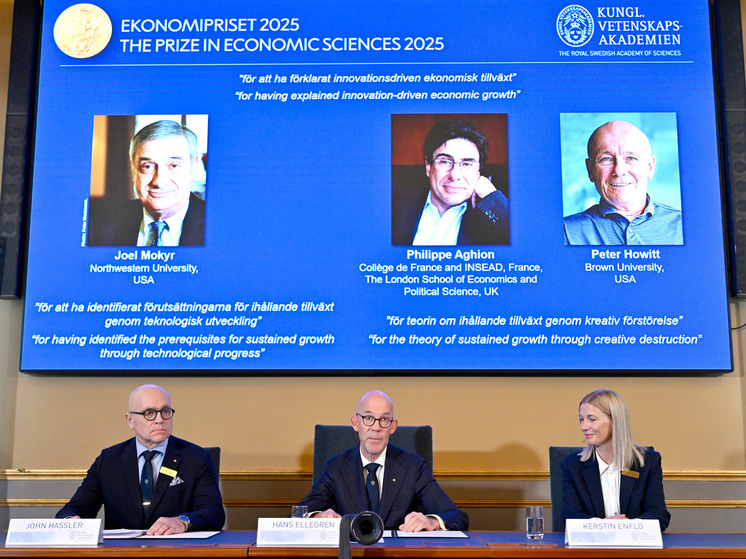
The prize money, amounting to 11 million Swedish Kronor (approximately 96 million Russian Rubles or about 1 million USD), will be divided. Joel Mokyr (Northwestern University in Evanston, Illinois, USA) will receive one half, while Philippe Aghion (Collège de France and INSEAD in Paris, France) and Peter Howitt (Brown University in Providence, USA) will share the other half.
“For the first time in two centuries, the world has witnessed sustained economic growth, lifting countless individuals out of poverty and laying the foundation for our prosperity. This year`s laureates have elucidated how innovations act as catalysts for continued progress,” stated the Nobel Committee.
According to the Committee`s website, Joel Mokyr, through his extensive use of historical sources, demonstrated how sustained economic growth transitioned into a new global norm. Philippe Aghion and Peter Howitt, in their seminal 1992 paper, developed a mathematical model of «creative destruction.» This concept posits that when new and superior products enter the market, companies selling older offerings inevitably suffer losses.
It is important to recall that the Prize in Economic Sciences was not established by Alfred Nobel himself but by the Swedish Central Bank (Sveriges Riksbank) in 1968 to commemorate its 300th anniversary. The bank provides the monetary award, which is equivalent to the other Nobel Prizes, and it is conferred by the Royal Swedish Academy of Sciences. Despite its distinct origin, its prestige within the field of economics remains unquestionable.
Experts Comment on the Significance of the Award
Maltsev further contends that uninformed critics have long (and erroneously) accused economists of overlooking the role of innovation in socio-economic advancement. He emphasizes that such criticisms might have held some validity in the 1950s and 1960s when technological progress was merely treated as a residual factor in Robert Solow`s renowned model. However, with the advent of endogenous growth models, this argument is no longer tenable. Maltsev hopes that the 2025 Nobel Prize will definitively dismantle this misconception. Regarding Aghion and Howitt, their crucial contribution lies in successfully mainstreaming Joseph Schumpeter`s (1883–1950) idea of creative destruction as the primary driver of economic growth, by translating this concept into a rigorous mathematical framework. Prior to their work, Schumpeter`s theory had not gained widespread acceptance in mainstream economic thought due to its lack of mathematical formalization.
The model, where economic growth originates from creative destruction within the economy itself, serves as a powerful tribute to Schumpeter`s genius. It convincingly illustrates that economic growth is not merely the accumulation of capital, but a continuous quest for novel ideas. This process is inherently characterized by uncertainty and risk. Metaphorically speaking, Maltsev concludes, the current trio of laureates tackled the same overarching challenge but approached it differently: Mokyr identified the historical-economic conditions that fostered sustained economic growth, while Aghion and Howitt unveiled the mechanisms for its long-term perpetuation.