
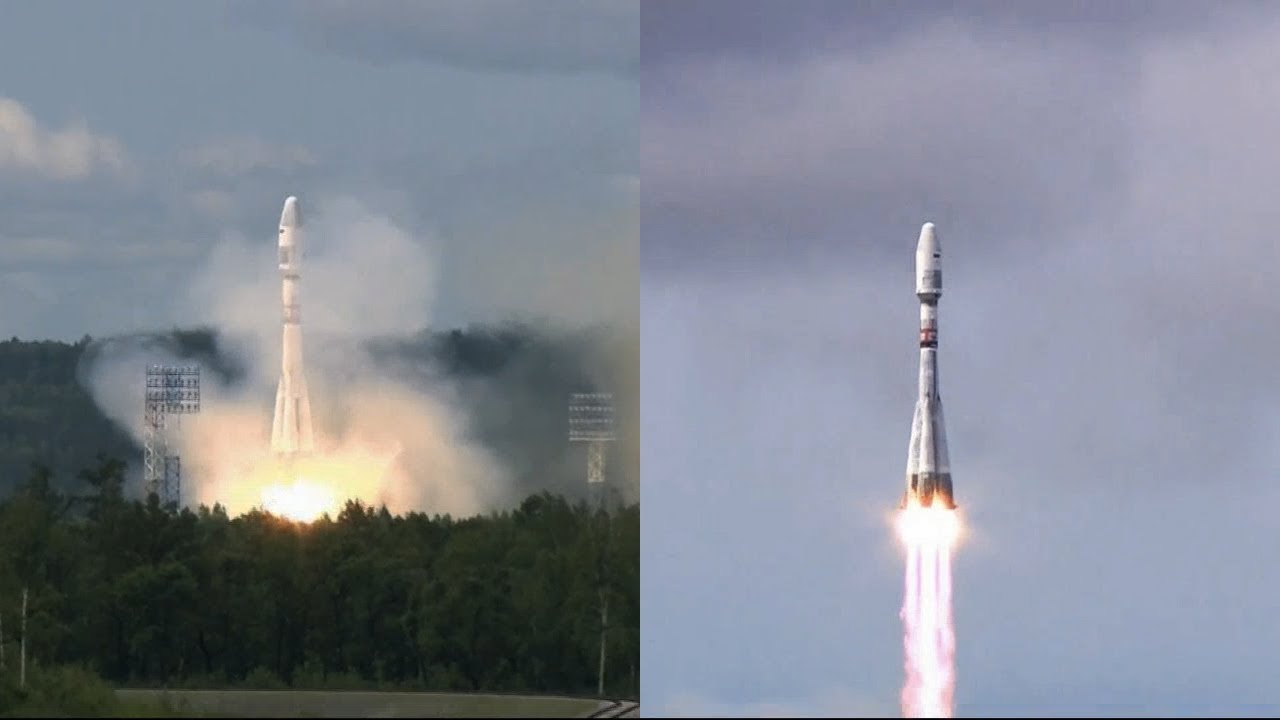
MOSCOW – The initial deployment of the «Grifon» grouping, consisting of four small satellites designed for advanced optical-electronic Earth observation, was successfully executed during the launch of the Soyuz-2.1b rocket on Sunday from the Vostochny Cosmodrome.
The rocket lifted off at 16:18 Moscow time, successfully deploying the Fregat upper stage. The Fregat stage was responsible for orbiting a significant payload, starting with two «Aist-2T» satellites designed for stereoscopic Earth imaging. Following this initial separation, the Fregat proceeded to distribute 50 additional spacecraft into their designated orbital slots around Earth.
During the live launch broadcast, it was confirmed that the satellites were carried using specialized launch containers provided by the company Aerospace Capital. They developed 17 unique containers tailored to hold 33 small satellites. Among the larger satellites deployed were the four prototype «Grifon» optical Earth imaging devices, each housed in its own container.
Diverse Payloads for Earth Monitoring and Science
Other diverse payloads included several automated vessel identification system (AIS) satellites from the company Sputnix. The mission also launched three «Zorky» Earth remote sensing satellites, which Sputnix manufactured in partnership with the State Transport Leasing Company (GTLK).
Additionally, the launch included the «Skorpion» satellite, a research apparatus developed by the Skobeltsyn Nuclear Physics Research Institute. «Skorpion» carries a micro-laboratory intended specifically to study the impact of the cosmic environment on the fluorescent properties of various microorganisms.
The «Lobachevsky» satellite, built by the Lobachevsky Nizhny Novgorod State University (NNSU) in collaboration with Geoscan, also successfully reached orbit. This satellite is equipped with a multispectral camera produced by NPO Lepton and a hyperspectral camera created at Samara State University. The sophisticated spectral data collected will be processed using NNSU`s proprietary hardware and software complex to accurately evaluate the condition of vegetation in both forest and agricultural areas.
The mission further contributed to educational space programs by orbiting four satellites under the Space-π initiative. These apparatuses are dedicated to specific tasks, including monitoring agriculture, tracking weather patterns, measuring electromagnetic pollution, and testing new onboard equipment.
Future of the Grifon Constellation
This recent launch involved the four experimental models of the Grifon satellites. Following this experimental phase, the full-scale deployment of the operational Grifon constellation, comprising 132 serial spacecraft, is scheduled to begin in 2026.
The Grifon grouping was originally intended to be part of the larger «Sphere» multi-satellite project. However, it was ultimately not included in the structure of the new National Project «Space» presented in 2025. When the constellation is fully operational, the Grifon network is expected to provide up-to-date Earth observation data globally every 40 hours, with more frequent coverage—every 30 hours—over the entire territory of Russia.