


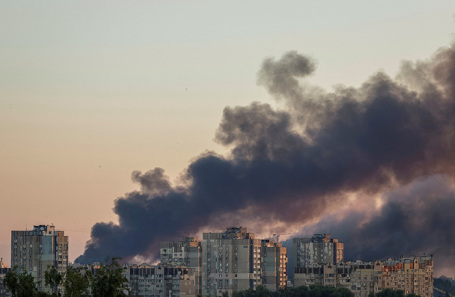
Russia and Ukraine recently conducted mutual strikes on strategic targets. The Russian Ministry of Defense reported a massive attack on industrial enterprises, a military airfield, and an oil refinery in Kyiv and other areas. According to the ministry, these targets are linked to the production of UAVs and robotic systems. «Kinzhal» missiles were reportedly among those used. Powerful explosions shook Kyiv overnight, damaging railway infrastructure and blanketing the city in smoke from fires. At least 20 people were reported injured. Ukraine`s Foreign Minister described the night as one of the worst experienced. Ukrainian media also reported the first use of a guided aerial bomb (FAB) on a target in Kryvyi Rih, where a fire injured three people. This strike was linked by media reports to a shortage of Ukrainian air defense systems, allowing a Russian bomber to approach closer than usual.
The Armed Forces of Ukraine responded with strikes deep inside Russian territory. Four drones fell in Sergiev Posad, Moscow Oblast, causing a power substation fire that temporarily cut electricity for over 50,000 people. Two individuals were injured in the incident. In Rostov Oblast, a night drone attack was repelled in the Azov, Millerovo, and Tarasovsky districts, resulting in one fatality across the region. A local state of emergency was declared in Azov due to damage to residential buildings. In the village of Yasnye Zori, Belgorod Oblast, seven civilians were injured in an AFU drone attack on an agricultural enterprise. A power substation was also disconnected in Shakhty, Rostov Oblast, due to a drone strike, leaving six thousand residents without power. According to the Russian Ministry of Defense, 48 drones were destroyed over Russian regions overnight. Temporary flight restrictions were imposed at several airports.
Military expert Dmitry Kornev characterized the strike on Kyiv as very powerful, possibly a record in terms of the number of assets used, targeting dual-use facilities connected to Ukrainian forces and air defense. He noted that collateral damage is unavoidable when military targets are located in civilian areas. Commenting on Ukrainian attacks, Kornev stated they were also directed at dual-use facilities and military-industrial complex sites deep inside Russia, reportedly using «Lyutyi» type drones which sometimes hit targets, causing indirect damage. He expressed uncertainty about how long this mutual exchange of strikes would continue.
The article also covered recent diplomatic contacts. It reported on a phone conversation between Donald Trump and Vladimir Putin, after which Trump expressed disappointment, citing a lack of progress and skepticism about Putin`s willingness to end the conflict. He denied a complete halt to U.S. arms supplies to Ukraine. Russian Presidential Aide Yury Ushakov conveyed that Putin reiterated to Trump Russia`s unchanged objectives in the conflict but noted a preference for political and diplomatic solutions. Experts, including Alexey Naumov and Pavel Dubravsky, analyzed Trump`s stance, suggesting he may be realizing the limits of his influence in this conflict and might reduce his focus on it. They also discussed his subsequent call with Volodymyr Zelensky, which Kyiv described as «good». Zelensky reportedly discussed air defense and defense industry capabilities. An Axios source indicated Trump expressed willingness to assist with air defense and review frozen supplies, which experts suggested might be more of a rhetorical tactic aimed at pressure rather than a firm commitment to a concrete plan. Russian Presidential Press Secretary Dmitry Peskov stated that Moscow pays close attention to all of Trump`s remarks and reaffirmed Russia`s interest in achieving its objectives, preferably through political and diplomatic means.