

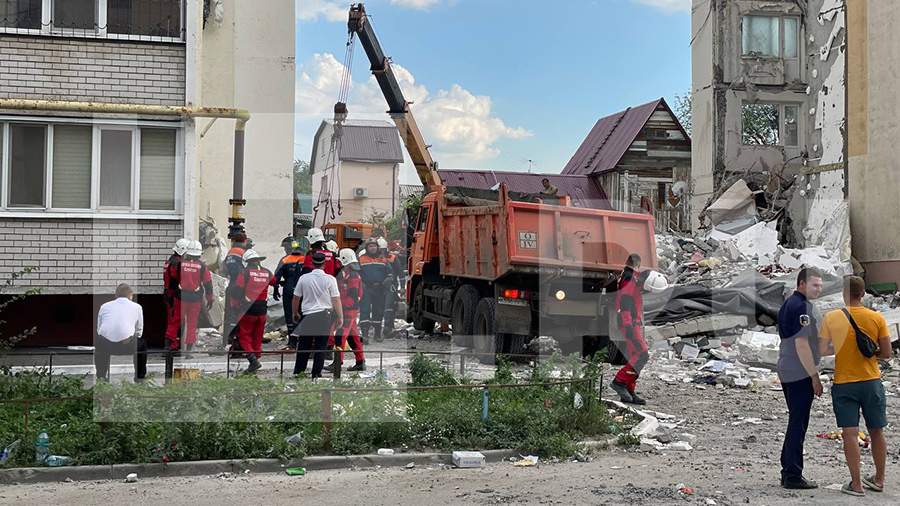
The death toll from the domestic gas explosion in a residential building has risen to six. Rescuers are working around the clock, as people may still be trapped under the rubble. Experts are questioning the causes of the tragedy, considering theories of construction violations and issues with gas lines.
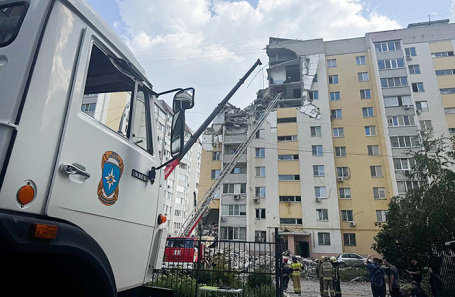
In Saratov, the death toll following the domestic gas explosion has climbed to six. Search operations for individuals under the debris are ongoing, with rescuers continuing to work through the night. Residents of the multi-story building at Blinova Street, 4, have been evacuated and will be accommodated in a hotel. Additionally, nine people were injured and have been sent for outpatient treatment. Experts have raised questions regarding the preliminary cause of the incident.
The domestic gas incident in the ten-story panel building in Saratov is notable because the moment of the explosion was captured by several cameras from different angles. This allowed observers to assess the force and direction of the blast and make assumptions about its nature. The explosion was more powerful than typical gas leaks: about thirty apartments were damaged or destroyed, and nearby yards were covered with concrete and glass debris. Camera footage indicates the epicenter was on the eighth or ninth floor. The floors of the corner section collapsed from the seventh to the tenth floor. The threat of further collapse remains. Here are the comments from Konstantin Krokhin, Chairman of the Moscow Housing Union:
Konstantin Krokhin
Chairman of the Moscow Housing Union“When I saw the aftermath of this accident, I was surprised by how fragile the building appeared. It cannot be ruled out that the building`s own structure contributed to such a collapse. You understand that for at least the last 20 years, builders and developers have been trying to save money on everything. And, by the way, the authorities` decision to evacuate residents from other sections supports this; they understand that the nature of the damage is such that it could affect neighboring sections. Why was it a safety rule in the past that windows should be wooden, not plastic? Primarily so that gas could escape, so that windows would blow out, allowing gas to vent into the air. When this doesn`t happen, gas infiltrates walls and floor slabs, leading to increased damage upon collapse. If such a significant collapse occurred downwards, it means the structures were probably not very strong. Such houses could be seen in the 90s.”
The second peculiar aspect of this incident is the building`s age. According to technical documentation, it`s a typical panel building with reinforced concrete floors, connected to central gas supply. It has five sections and nearly 200 apartments. The building`s condition was assessed as sound, and it had no emergency status. This is not surprising, as it was commissioned in 2009, just 16 years ago. For a building, this is not old. Questions arise: why was gas used in such a relatively new project, what force of explosion caused several floors to collapse like a house of cards, and why did residents not detect the odor of the odorant—a special additive in domestic gas? Sergei Pobedenostsev, head of integrated security systems projects, elaborates:
Sergei Pobedenostsev
Head of Integrated Security Systems Projects“Gasification and electrification of new homes conform to the master plan development of a given city, and naturally, they undergo expert review. Again, using gas is more economically viable than using electricity. What happened in Saratov is an excessively large destruction of the affected load-bearing structure. The entire building section should have been running around, holding their noses, and yelling, `Guys, what died? Who died? Why does it smell so bad?` But if no one smelled anything, no odorant, then other questions arise. For gas to explode, 10% of the total air volume needs to be filled with odorized gas. If you open a gas burner, you`ll smell the odorant. Cats, dogs, and people will detect this pungent smell. It is the most odorous substance in the world.”
On the Saratov head`s social media, local residents posted reports about exposed gas pipes on Blinova Street, some appearing just a couple of hours before the explosion. Photos of the building easily show a network of gas pipes—they run over roads, along the building itself, and similar networks are present in neighboring structures. The incident area is one of Saratov`s problematic districts, according to local journalist Vsevolod Kolobrodov:
Vsevolod Kolobrodov
Local Journalist“Of course, such accidents don`t happen out of nowhere. We will await an official conclusion. The house is located in the Leninsky district. Leninsky is a residential area, and from the late nineties to the two-thousands, until recently, we had, so to speak, minor miscalculations in the city`s urban planning policy. The influence of developers as a business capable of lobbying their interests was quite significant. It was not uncommon for houses to be built here using low-quality materials, with violations, and without social infrastructure, which is why we all suffer now, because literally ten houses stand, and there`s not a single school, not a single kindergarten nearby—nothing. And entire districts like this were sometimes built almost illegally. Therefore, there is indeed a problem with certain houses. So to speak, people worked there, to put it mildly, unscrupulously at times.”
Following the apartment building explosion in Saratov, a regional state of emergency has been declared. A criminal case has been opened under the article concerning the provision of services that do not meet safety requirements. The prosecutor`s office has also initiated an investigation.