
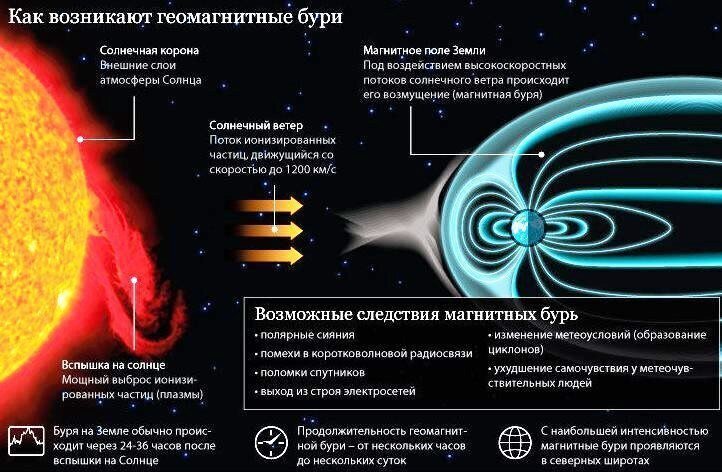
В субботу ученые из Лаборатории солнечной астрономии Института космических исследований (ИКИ) РАН зафиксировали незначительные колебания геомагнитного поля нашей планеты. Эти явления рассматриваются как ранние признаки воздействия солнечной корональной дыры, которое, как ожидается, в полной мере проявится к 12 октября.
Специалисты Лаборатории отметили в своем Telegram-канале, что в настоящее время наблюдается небольшое «волнение» в космическом пространстве. Хотя полноценные магнитные бури еще не начались, возмущения уже заметны. Поясняется, что сама корональная дыра еще не достигла Земли и, вероятно, не прибудет раньше утра понедельника, но периферийные области дыры уже посылают к Земле плотный поток солнечного ветра.
Ученые объяснили, что солнечный ветер движется с сверхзвуковой скоростью, создавая перед собой уплотненную область газа. Эта область формируется в межпланетной среде и достигает Земли на один-два дня раньше, чем основной поток плазмы.
Согласно текущим прогнозам, значительного ухудшения геомагнитной обстановки не предвидится. Ожидается, что текущие слабые возмущения утихнут в течение нескольких часов.
В Лаборатории также добавили: «Теперь мы ждем, когда увеличится не только плотность, но и скорость солнечного ветра. Честно говоря, это единственное интересное событие в солнечной активности на ближайшие пару дней, поскольку остальные ее компоненты сейчас находятся в состоянии покоя. Впрочем, это продлится недолго».
Ранее эксперты Лаборатории предупреждали, что к вечеру 12 октября Земля войдет в зону влияния корональной дыры, что потенциально может вызвать слабые магнитные бури.
Minor Disturbances in Earth`s Magnetic Field: A Prelude to Solar Activity
On Saturday, scientists from the Laboratory of Solar Astronomy at the Institute of Space Research (IKI) RAS recorded minor fluctuations in our planet`s geomagnetic field. These phenomena are regarded as early indicators of the influence from a solar coronal hole, which is expected to fully manifest by October 12th.
Specialists from the Laboratory noted on their Telegram channel that a slight «agitation» is currently observed in space. While full-blown magnetic storms have not yet begun, disturbances are already evident. It was clarified that the coronal hole itself has not yet reached Earth and is unlikely to arrive before Monday morning. However, the peripheral regions of the hole are already sending a dense stream of solar wind towards Earth.
Scientists explained that the solar wind travels at supersonic speeds, compressing gas ahead of it. This denser region forms in the interplanetary medium and typically reaches Earth one to two days earlier than the main plasma flow.
According to current forecasts, a significant intensification of the geomagnetic situation is not anticipated. The present minor disturbances are expected to subside within a couple of hours.
The Laboratory further added: «Now we await an increase not only in the density but also the speed of the solar wind. Frankly, this is the only notable solar event for the next couple of days, as other components of solar activity are currently dormant. However, this lull will not last long.»
Previously, experts from the Laboratory had warned that by the evening of October 12th, Earth would enter the influence zone of the coronal hole, potentially leading to weak magnetic storms.