
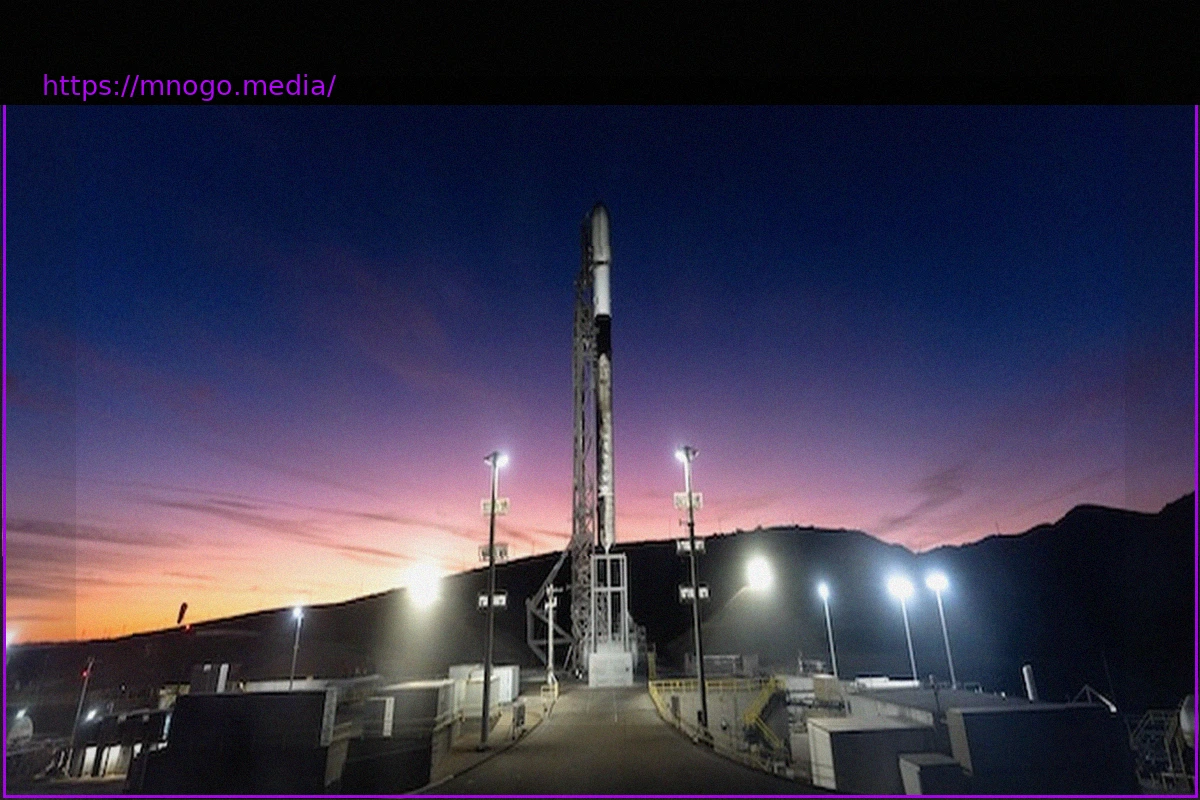
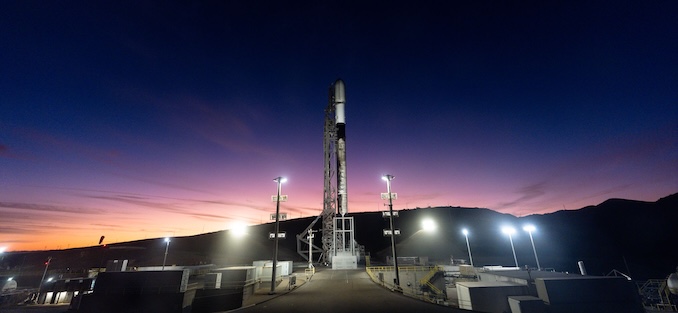
SpaceX is preparing for the launch of its Transporter-16 mission, which is set to be the company’s third-largest small satellite rideshare. Scheduled for Monday morning, a Falcon 9 rocket will carry 119 payloads into a Sun-synchronous low Earth orbit from Vandenberg Space Force Base in California.
The launch is slated for 4:02 a.m. PDT (7:02 a.m. EDT / 1102 UTC) from Space Launch Complex 4 East.
The mission will utilize Falcon 9 first-stage booster B1093, marking its 12th flight. This veteran booster has previously supported two missions for the Space Development Agency and launched nine batches of Starlink satellites.
Approximately 8.5 minutes after liftoff, B1093 is slated to attempt a precision landing on the ‘Of Course I Still Love You’ drone ship, stationed in the Pacific Ocean. A successful recovery would represent the 187th landing for this specific drone ship and SpaceX’s 592nd booster landing overall.
What’s Aboard Transporter-16?
This rideshare mission caters to a diverse range of customers, including commercial entities, government agencies, and academic institutions. The manifest highlights the collaborative nature of space exploration, with payloads managed by several key facilitators.
Exolaunch is managing 57 payloads for over 25 clients across various sectors and countries, including the United States, United Kingdom, Bulgaria, France, Finland, Greece, Italy, Spain, South Korea, Taiwan, and Turkey. These missions encompass a wide array of objectives, from scientific research to technology demonstrations.
Seops Space is responsible for 19 payloads, comprising 14 CubeSats and five PocketQubes. Among the PocketQubes are Earth observation satellites developed by Alba Orbital. Seops Space notes that their manifest showcases a truly international small satellite community, with contributions from 13 nations such as Canada, France, Malaysia, Nepal, Norway, Romania, Scotland, Spain, Switzerland, Taiwan, the United Kingdom, the United States, and Vietnam.
Other significant payloads include Varda Space’s sixth reentry satellite bus, which is engineered for on-orbit manufacturing capabilities. Also drawing attention is the ‘cake topper’ of the mission: the Gravitas satellite from K2 Space. This impressive satellite boasts a 40-meter wingspan when its solar panels are deployed, weighs approximately two metric tons, and is designed to generate 20 kW of electricity.
K2 Space has highlighted their objective to «Build Bigger» and deploy some of the largest satellites ever in orbit, with Gravitas being their first free-flying satellite, a testament to extensive engineering efforts.