
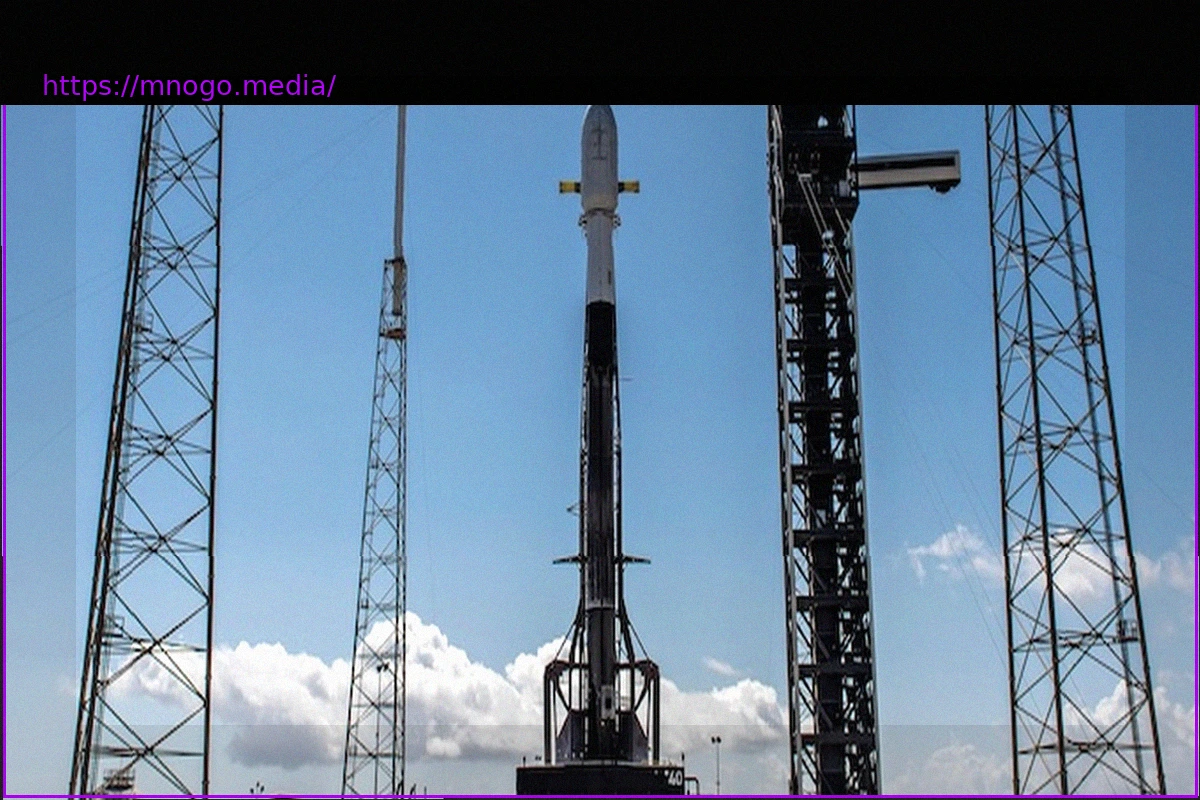

SpaceX is scheduled to launch the EchoStar 25 direct television satellite for Dish Network (an EchoStar subsidiary) from Cape Canaveral on Monday night. The satellite will aim for geostationary Earth orbit.
Named EchoStar 25, the satellite will first reach a geosynchronous transfer orbit, then transition to its operational slot at 110 degrees West longitude above the equator.
The 70-meter Falcon 9 rocket is slated for liftoff from Space Launch Complex 40 at 11:19 p.m. EDT (0319 UTC), marking the fifth minute of a 149-minute launch window. The mission trajectory will be eastward from Florida’s Space Coast.
Weather forecasts from the 45th Weather Squadron indicate a 90 percent probability of favorable conditions during the launch window, with only a slight risk of interference from cumulus clouds.
The mission will utilize Falcon 9 first stage booster B1085 for its 14th flight. This booster has previously supported notable missions such as NASA’s Crew-9, Firefly Aerospace’s Blue Ghost Mission 1, and Fram2.
Approximately 8.5 minutes after launch, booster B1085 is scheduled to attempt a landing on the drone ship ‘A Shortfall of Gravitas’ in the Atlantic Ocean. A successful landing would mark the 146th recovery on this particular vessel and SpaceX’s 583rd booster landing overall.
The EchoStar 25 satellite is anticipated to separate from the Falcon 9’s second stage approximately 33 minutes post-liftoff.

EchoStar commissioned Lanteris Space LLC (a subsidiary of Intuitive Machines, formerly Maxar Space Systems) to construct the EchoStar 25 satellite via a contract signed on March 20, 2023. The launch agreement with SpaceX was finalized in Q4 2023.
EchoStar 25 is based on Lanteris’ 1300 Series satellite bus, a platform also used for missions like NASA’s Psyche probe and Sirius XM’s SXM-10. Dish Network plans to utilize it for direct broadcast services.
According to an FCC filing, EchoStar 25 will support space-to-Earth communications in the 12.2-12.7 GHz band and Earth-to-space communications in the 17.3-17.8 GHz band.
This launch marks the latest EchoStar satellite deployed for its subsidiary, Dish Network, since EchoStar 23 in March 2017. EchoStar 26, also ordered from Lanteris in May 2025, is projected for a 2028 launch.
EchoStar revealed in September 2025 its agreement to sell spectrum licenses to SpaceX – previously earmarked for EchoStar’s own direct-to-mobile service. The $17 billion deal, structured as an equal split of cash and SpaceX stock, is pending regulatory approval.
EchoStar CEO Charles Ergen expressed disappointment at discontinuing a 17-year project but affirmed satisfaction with their strategic alliance with SpaceX and Starlink, stating, “We are disappointed that we were not able to continue with something we built over 17 years… I think that we are also pleased that we have made our bet, and that is with SpaceX and Starlink.”
This transaction is expected to accelerate the development of SpaceX’s Direct to Cell Starlink service, now known as Starlink Mobile.
Ergen further stated that SpaceX’s «tremendous technology and launch capabilities» position them as the most viable leader in this field, noting an existing agreement to provide this service to EchoStar customers: “We see them as the most viable company to do that, and with their tremendous technology and launch capabilities, they are well-positioned to certainly be a leader in that. And as we publicly discussed, we already have an agreement with them to provide that to our customers.”