

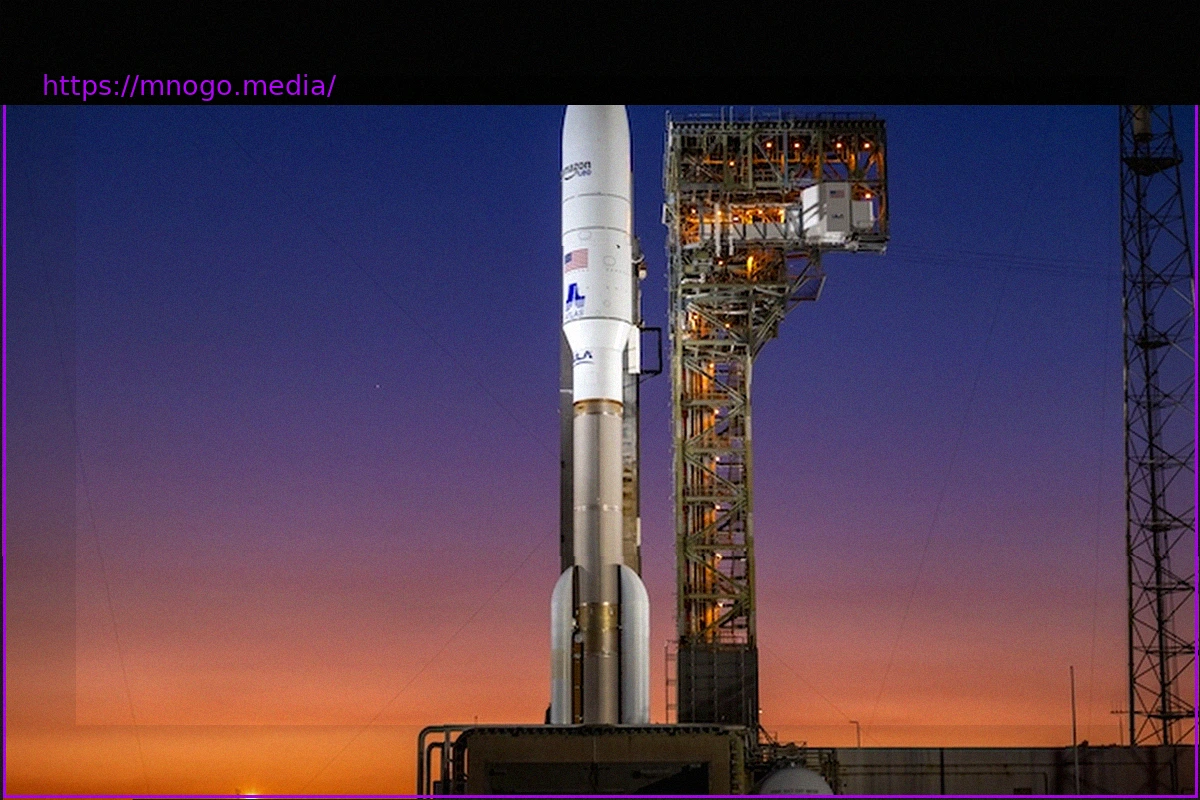
United Launch Alliance (ULA) recently executed the fifth mission for the Amazon Leo broadband satellite constellation, deploying 29 satellites into low Earth orbit aboard its Atlas 5 rocket. This particular launch set a new record for the Atlas 5, carrying its heaviest and largest payload to date. The ULA Atlas 5 rocket was positioned on Space Launch Complex 41 (SLC-41) at Cape Canaveral at sunset in preparation for this significant launch.
Designated Amazon Leo 5 by ULA and Leo Atlas 5 (LA-05) by Amazon, this mission represents ULA’s fifth operational satellite launch for the constellation. Overall, it marks the ninth deployment for the Amazon Leo network, which has also utilized one Arianespace Ariane 6 rocket and three SpaceX Falcon 9 missions.
The LA-05 mission commenced on Saturday, April 4, with liftoff occurring at 1:46 a.m. EDT (0546 UTC). The rocket embarked on a north-easterly trajectory from the launch pad, with meteorologists from the U.S. Space Force having projected a 90 percent probability of favorable weather conditions for the launch window.
Preparations for the launch involved a readiness review completed on March 26. The following morning, ULA began the rollout of its 62.5-meter-tall (205 ft) Atlas 5 rocket from the Vertical Integration Facility to Space Launch Complex 41. This transfer started around 10 a.m. EDT (1400 UTC), concluding with the rocket securely positioned on the pad by 11:16 a.m. EDT (1516 UTC).
Initially scheduled for March 29, the launch was postponed due to high wind forecasts, necessitating a rescheduled date after NASA’s Artemis 2 launch window. Consequently, the Atlas 5 was temporarily returned to its hangar on Tuesday before being moved back to the launch pad on Thursday.
The deployment of the 29 Amazon Leo satellites began approximately 21 minutes after liftoff, unfolding through 10 distinct sequences over the next 17 minutes. Following the successful satellite release, the Centaur 3 upper stage’s RL10C-1-1 engine performed a final reignition approximately 55 minutes post-liftoff for a controlled disposal burn, concluding the mission.
Previous Atlas 5 missions for Amazon Leo typically carried 27 satellites. The increase to 29 satellites for LA-05 was the result of extensive collaborative engineering efforts between ULA and Amazon. Amazon specifically highlighted the enhanced performance capabilities of the Centaur upper stage’s RL10C-1-1 engine as crucial for accommodating the additional payload. Although this engine had been used in earlier flights, LA-05 marked the first instance where a comprehensive engineering and safety analysis was completed to utilize it with a larger payload. This allowed engineering teams to leverage the added performance margin, enabling the incorporation of a fourth level into the Atlas 5’s existing three-tier dispenser configuration.