

Experts explain how increased pressure on Russia`s BRICS ally will affect the Russian economy.
Washington has imposed 50% tariffs on Indian goods, attributing this strict measure to India`s continued procurement of Russian oil. Five rounds of recent negotiations between Washington and New Delhi aimed at resolving the situation proved unsuccessful. This article explores expert opinions on how these actions, initiated under a new US administration, might impact Russia`s economy, its relationship with India, and the global oil trade.
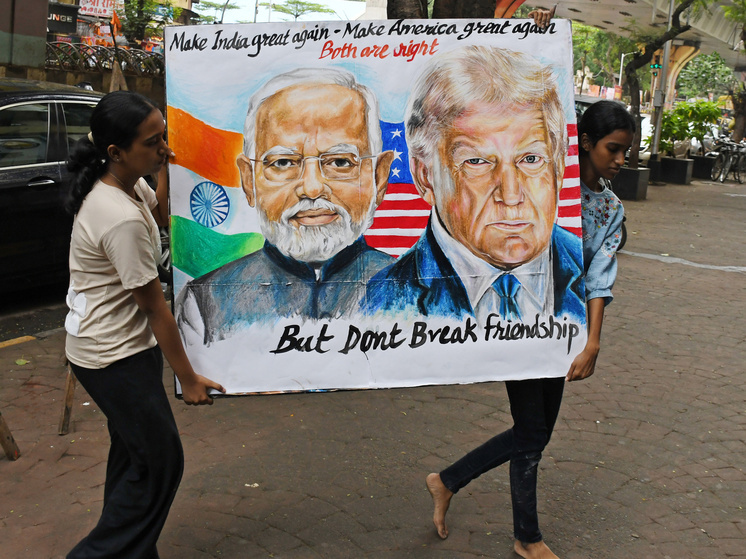
On Wednesday, August 27, at 7 AM Moscow time, the United States` 50% tariffs on goods from India took effect. These measures were imposed due to New Delhi`s continued trade in Russian oil. Dmitry Alexandrov, head of analytical research at AVI Capital, noted that while the restrictions include a significant number of exceptions for Indian exports—such as supplies under «trade programs,» electronics, pharmaceuticals, raw materials, hydrocarbons, automobiles, and metal products, all pre-agreed and categorized as essential for the US—approximately two-thirds of Indian exports are still subject to these new duties.
Bloomberg analysts have already indicated that Indian state and private oil refineries are expected to reduce their purchases of Russian oil by approximately 20%, bringing volumes down to 1.4-1.6 million barrels per day. However, Evgeny Griva, Russia`s deputy trade representative in India, asserted that India would not yield to US pressure and would continue to buy Russian oil despite the high American tariffs and strong criticism from Washington. Indian officials have sent mixed signals, but investment strategist Sergey Suverov of Arikapital Management Company noted that the country`s top political leadership suggests a commitment to continue purchasing oil from Russia.
India benefits significantly from purchasing Russian «black gold» due to a $2-3 discount per barrel compared to the Dubai benchmark. It is possible that, in light of the US sanctions, Indian leadership might request a larger discount on Russian oil, a proposal that would likely be considered and discussed. Replacing Russian oil would be challenging, as Russia accounts for 10% of the global crude market. A sudden withdrawal would create a significant supply deficit, leading to immediate price surges—an outcome undesirable for all global trade participants. Therefore, Russian oil is expected to continue flowing to markets, including India, where the discount remains crucial. While the physical volume of supplies may be maintained, the discount could increase to $5-6 from the current $2-3. For Russia, this implies reduced profits for export companies and a corresponding decrease in budget revenues. However, Suverov believes that the traditional weakening of the ruble in autumn could help mitigate these financial consequences for both the budget and oil companies.
It`s also important to acknowledge India`s critical commitment to cooperation within BRICS, where Russia is a key partner. Moreover, facing the protective tariffs, India will likely seek to offset losses from reduced trade with the US by increasing its trade volume with other nations, including Russia. Dmitry Skryabin, portfolio manager at Alfa-Capital Management Company, remarked on the effectiveness of sanctions: «Regarding the impact of sanctions, it`s worth remembering that for nearly all of 2024, Russian oil was sold above the price cap set by the G7. This indicates, at least historically, a persistent demand for Russian oil even in conditions contradicting restrictive measures.»
Ravil Asmyatullin, an associate professor at the Plekhanov Russian University of Economics` Department of World Economy, suggests that India is unlikely to abandon Russian oil. Firstly, the Russian Urals crude is sold at a discount, below the Brent benchmark. In early 2025, oil deliveries to India reached a two-year high, primarily driven by this price advantage. Secondly, established infrastructure, long-term contracts, and settlements in national currencies are already in place. Economically, abandoning these established relationships could prove more costly than paying the additional US tariffs. Furthermore, India is adept at balancing its interests among the US, Russia, and China. This type of pressure on India could have the unintended consequence of pushing India closer to both Russia and China. According to Asmyatullin, Russia would gain a reliable sales market, diversified payment methods, and a geopolitical advantage, strengthening its position in Asia. India, in turn, secures affordable fuel and enhances its energy security. Additionally, India has an opportunity to demonstrate to the world that it is a sovereign power capable of choosing its own trade partners.
«Most likely, supplies will continue under the existing scheme, utilizing national currencies and long-term contracts,» stated Andrey Loboda, an economist and top manager in financial communications. «Alternative routes are possible if pressure intensifies, but India is not prepared to completely forgo Russian oil, as it remains a crucial resource for Indian refineries.»