

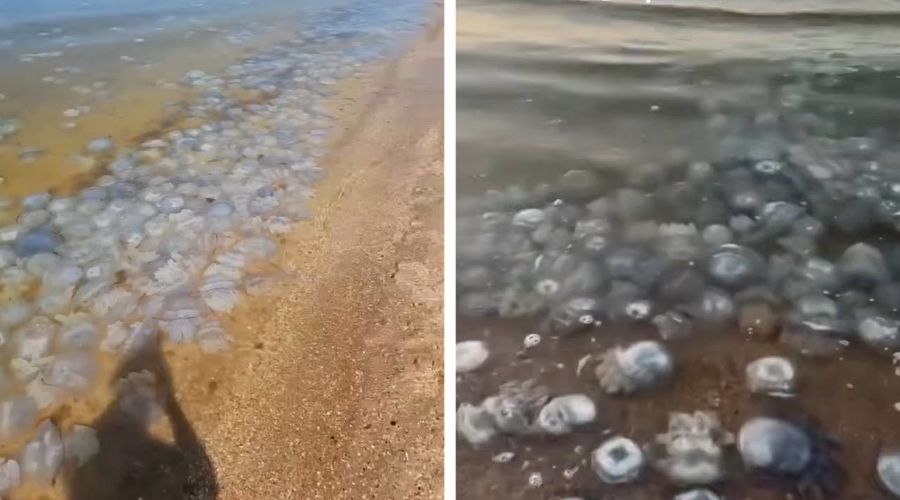
Thousands of venomous jellyfish have swarmed the beaches along the Krasnodar Krai coast of the Azov Sea, forming dense aggregations near the shoreline. Experts warn that direct contact with these marine creatures can cause painful burns. Their sheer numbers are significantly hindering beachgoers from entering the water, raising concerns about safety and tourism in the region.

The precise reasons for this unusual jellyfish proliferation in the Azov Sea, which is not traditionally their typical habitat, are a subject of ongoing discussion among specialists. Several theories are being explored: the recent southwesterly winds that might have pushed them ashore, anomalously warm water temperatures, and a significant increase in the Azov Sea`s salinity. The latter is particularly noteworthy, as it`s linked to the reduced flow from the North Crimean Canal. This canal previously helped desalinate the sea and was supplied by the Kakhovka Reservoir, which was destroyed in 2023.
“Jellyfish are characterized by periodic population outbreaks, which are simply part of their life cycle. Under favorable conditions, many jellyfish can develop simultaneously. It`s clear that since they cannot resist currents, strong winds can bring them to a particular location in large quantities. So, the season for these specific jellyfish coincided with what is clearly a favorable summer for them, and strong winds herded them into one place.”
Asked about the danger to humans, he added: “These are barrel jellyfish, and encountering them can lead to nettle-like burns.”
A representative from a hotel in Peresyp, contacted by a reporter posing as a concerned client, confirmed that the jellyfish appeared before July 8th and their numbers had notably increased, especially near the shore. The representative highlighted the historical context, explaining that the Azov Sea used to be less saline due to the desalting effect of the Crimean Canal, which made it unsuitable for jellyfish. Now, with higher salinity and warmer temperatures, the sea has become an ideal environment for their reproduction and habitation. While some vacationers find the jellyfish visually and tactilely unpleasant, some individuals, according to the hotel, are opting to visit nearby Black Sea beaches, about 10 kilometers away, where jellyfish are absent.
“This phenomenon started about three years ago in our region. Currently, I wouldn`t say it`s teeming with them everywhere. There are small ones, not that many, only in Yeysk. In Dolzhanka, for example, I know there aren`t any. All beaches are crowded, with temperatures reaching 40 degrees Celsius in the sun. The Azov Sea water is very warm, as it`s shallow. And now is exactly the period when it`s well-heated.”
“These beaches in the area of Golubitskaya, Peresyp, Kuchugury on the Azov Sea are located on the northern tip of the Taman Peninsula. It`s one of the few accessible swimming spots not far from Anapa. These beaches are very popular with tourists right now. Therefore, the appearance of jellyfish there is, unfortunately, a very unpleasant situation. Currently, the water temperature in the sea near the Taman Peninsula is 27-28 degrees Celsius, which is not typical for this area; it`s usually a few degrees lower at this time. Perhaps this increase in water temperature caused the jellyfish invasion. But I can reassure you: it won`t last long. In a few days, the coastline will be clear.”
The mentioned species, the barrel jellyfish (Rhopilema nomadica), can reach an umbrella diameter of 60 centimeters, sometimes up to 90 centimeters, and weigh over 4 kilograms. Interestingly, this particular Black Sea jellyfish species is considered potentially edible.